

Third-party risk management in the UAE
The third-party lifecycle, stage by stage.
Nine stages, from knowing who your third parties are to reporting to the Board. Each stage shows what good looks like, who usually owns it, the UAE rules that apply, and what NexaPair does today.
Rules are drawn from our source-by-source regulatory map, checked on 3 November 2026. Secondary source means law-firm or other secondary sources only; To be confirmed means reported but not verified.
Stage 1 of 9
Strategy and inventory
What good looks like
A Board-approved strategy and policy for third parties, and one complete register of every third party, outsourcing arrangement and intragroup service, each with a named owner.
Usually owned by: Risk, with Procurement and the Board
Questions to ask
- Is every third party in one register, including software, custodians and group companies?
- Does the Board itself approve the third-party strategy and policy?
- Can you name the owner of each arrangement?
In NexaPair
- LiveOutsourcing register
- LiveBoard pack
- LiveCSV and JSON exports of 10 registers, including the audit trail
UAE rules that apply
CBUAE Board-approved strategy, policies and processes for third-party risk, integrated into the operational risk framework.
CBUAE Do not over-rely on outsourcing; keep enough in-house staff, expertise and resources to run licensed activities.
CBUAE Keep a complete, current register of all outsourcing (material and non-material), solo and group-wide, with provider details, dates, service description, whether Confidential Data is involved, and materiality.
FSRA The FSRA expects a full list of all providers, including software, custodians and group functions, with materiality assessed. Intragroup arrangements are outsourcing.
VARA Keep an Outsourcing Policy and a register with provider, scope, location, dates, contacts, materiality, and whether personal or confidential data is involved.
Stage 2 of 9
Classification and tiering
What good looks like
Each third party gets a risk tier from what it does, the data and systems it touches, where it works and whether it supports a critical operation. Materiality is decided by written criteria.
Usually owned by: Risk, with business owners and Information Security
Questions to ask
- Which of your third parties support a critical operation?
- Are your materiality criteria written down and applied the same way each time?
- Does access to data or systems raise the tier automatically?
In NexaPair
- LiveExplainable risk score with factor weights and minimum-tier rules
- LiveCritical-operations register
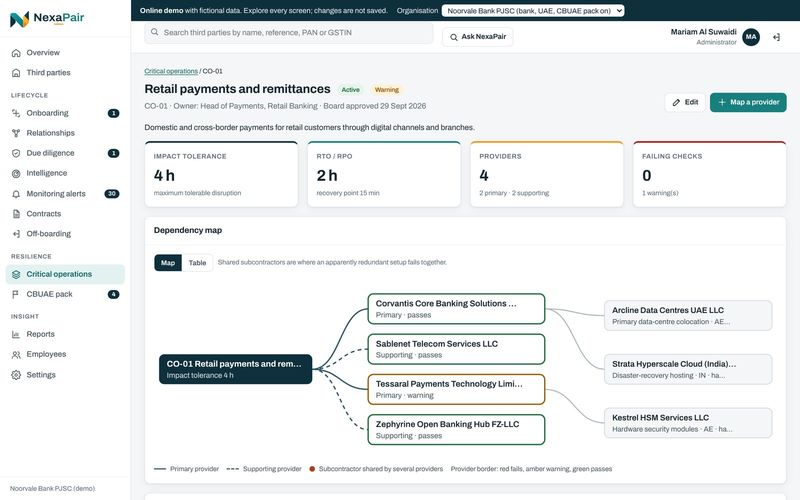
- LiveVendor and subcontractor (fourth-party) mapping
UAE rules that apply
CBUAE Identify the assets each Critical Operation depends on, including third-party service providers and intragroup entities, and record this in a mapping per Critical Operation that is updated through change management.
CBUAE Minimum list of what counts as Critical Operations (e.g. payment and time-critical services, accurate financial records, solvency and liquidity management, and any operation the CBUAE deems critical).
CBUAE Materiality criteria: effect on risk control and performance, impact of provider failure, effect on regulatory compliance, and the nature of the data shared.
FSRA Risk-rate providers to drive review frequency. Monitor KPIs, adverse news and ownership changes. Have a policy on onsite visits for overseas providers.
Stage 3 of 9
Due diligence
What good looks like
Checks finished before anyone signs, in proportion to the tier: who the vendor is and who owns it, its licence and tax registration, sanctions, financial strength, security and resilience, and any links to your own staff.
Usually owned by: Compliance and Procurement, with Information Security and Finance
Questions to ask
- Is due diligence always finished before signature?
- Do you know each vendor's beneficial owners?
- Do you confirm the trade licence with the authority that issued it?
In NexaPair
- LiveDue diligence cases by tier
- LiveRelationship intelligence: vendor and employee links by phone, bank account, director or address
- LiveSanctions and PEP screening via OpenSanctions
- LiveBeneficial owners at 25% or control, declared and screened
- LiveUAE trade licence record with evidence review and expiry alerts
- LiveTRN format check with EmaraTax evidence
UAE rules that apply
CBUAE No third-party arrangement without first doing a risk assessment and due diligence.
CBUAE Provider due diligence should cover financial capacity, experience, governance and internal controls, security including cyber, staffing, and country and legal risk.
DFSA Do due diligence when choosing providers, supervise the outsourced work effectively, and deal with any provider act or failure that could breach DIFC law.
Federal law A beneficial owner is a natural person owning or controlling 25% or more of shares or votes, directly or indirectly. If there is none, record whoever controls by other means; failing that, the senior managing official. Secondary source
Federal law A TRN is 15 digits and starts with '100'. Verify it on the FTA's public EmaraTax TRN verification service (no login; CAPTCHA). The result shows legal name, TRN and status. One TRN generally covers VAT and corporate tax, but status can differ by tax type. Secondary source
Federal law Check onshore licences and activities via the NER (growth.gov.ae). Confirm against the issuing authority (DED/DET, free zone authority, or the DIFC/ADGM registers), since free-zone coverage in the NER is not confirmed. Secondary source
Stage 4 of 9
Contracting
What good looks like
A written contract that gives you and your regulator access, settles data ownership and location, reaches subcontractors, requires prompt incident notice and allows an orderly exit.
Usually owned by: Legal, with Compliance and Information Security
Questions to ask
- Does the contract give your regulator access and on-site rights where the rules require them?
- Must the vendor tell you about an incident early enough for you to meet your own clock?
- Do the same terms reach the vendor's subcontractors?
In NexaPair
- LiveContracts and obligations
- LiveVendor and subcontractor (fourth-party) mapping
- LiveUAE requirements pack for seven regimes: CBUAE, DFSA, FSRA, CMA, VARA, government and federal
UAE rules that apply
CBUAE Legally binding written contracts covering rights, duties, data ownership, confidentiality and termination. For Critical Operations, the LFI must be able to inspect records and receive audit and risk reports.
CBUAE Contracts must oblige the provider to comply with CBUAE requests and reporting, and to allow CBUAE on-site examinations for Critical Operations outsourcing.
CBUAE Where customer or LFI data passes to subcontractors, the contract and CBUAE-access terms must also apply to them and be enforceable by contract.
DFSA The written contract must require the provider to supply information, give access to its premises, and deal openly and cooperatively with the DFSA.
VARA Written contracts with mandatory terms. Material outsourcing adds service levels, contingency testing, regulator cooperation, exit assistance, insurance, and specified data and processing locations. Client data is returned or destroyed on exit.
DFSA Processing for a controller needs a legally binding written agreement with set contents: subject matter, duration, nature and purpose, data types, data subject categories, and processor commitments.
Stage 5 of 9
Onboarding and approvals
What good looks like
Regulator notices and approvals are made before the arrangement starts, data sits where the rules require, and the vendor gets only the access it needs.
Usually owned by: Compliance, with Operations and Information Security
Questions to ask
- Does this arrangement need a regulator's non-objection, or notice in advance?
- Will the master system of record and personal data stay where your rules require?
- Has any data reached the vendor before onboarding finished?
In NexaPair
- LiveMaterial-change notice and non-objection gate
- LiveMaster-system-of-record location check
- LiveDeployable in a UAE cloud region
- LiveCross-border transfer assessment under the PDPL or the DIFC and ADGM data protection laws
UAE rules that apply
CBUAE Obtain a CBUAE notice of non-objection before outsourcing any activity whose disruption could significantly affect Critical Operations.
CBUAE The Master System of Record (all data, including personal data, needed to run Critical Operations) must be continuously maintained and stored in the UAE, including when activities are outsourced. Branches of foreign institutions may, with CBUAE approval, instead keep an up-to-date copy in the UAE.
CBUAE Prior CBUAE non-objection is needed to outsource any material activity, including to related parties. Core banking and key control functions (senior management oversight, risk, compliance, internal audit) are generally not permitted to be outsourced.
DFSA Inform the DFSA of any material outsourcing arrangement.
VARA Notify VARA in advance of any new or materially changed Material Outsourcing. VARA may object, and its concerns must be resolved first.
CBUAE Do not expose personal data to an API provider until onboarding and due diligence are complete. Pen-test the institution's and API providers' systems.
Stage 6 of 9
Ongoing monitoring
What good looks like
Performance, risk and financial condition are watched for the life of the relationship, sanctions lists are re-screened after each update, and review frequency follows the tier.
Usually owned by: Business owners, with Compliance and Risk
Questions to ask
- Do you re-screen vendors as soon as the UAE or UN lists change?
- Does review frequency follow the risk tier?
- Who hears about a change in a vendor's ownership or financial health?
In NexaPair
- LiveAlerts for sanctions, GST filing, financial health and litigation
- LiveSanctions and PEP screening via OpenSanctions
- LiveScreening against the UAE Local Terrorist List and the UN list, with freeze and goAML report clocks
- LivePassive outside-in cyber posture: an A to F grade per vendor, history, scheduled re-checks and grade-drop alerts
- LiveQuestionnaires in Arabic and English with AI evidence review that a person signs off
UAE rules that apply
CBUAE Resource third-party oversight. Minimum controls: an updated register of outsourced activities and third-party arrangements (for Critical Operations), performance and risk metrics, ongoing assessment including the provider's financial condition, and dependency management.
FSRA Risk-rate providers to drive review frequency. Monitor KPIs, adverse news and ownership changes. Have a policy on onsite visits for overseas providers.
VARA Risk-assess each arrangement, including materiality. Due diligence covers capacity, financial soundness, reputation, regulatory status, reliance on subcontractors and virtual-asset expertise.
Federal law Screen customers, counterparties, beneficial owners and related persons against the UAE Local Terrorist List and the UN Consolidated List. Subscribe to EOCN email alerts and re-screen immediately after each update.
Federal law Freeze funds of listed persons without prior notice. Do not provide funds or services without EOCN permission.
Stage 7 of 9
Incidents and issues
What good looks like
A vendor incident that touches a critical operation starts your reporting clocks straight away. Each issue has an owner, a record of what happened and a fix that someone checks.
Usually owned by: Operations and Risk, with Compliance
Questions to ask
- Which clock starts first for your firm, and who sends the notice?
- Will your vendor tell you in time for you to meet it?
- Is each incident linked to the vendor record, so it shapes the next review?
In NexaPair
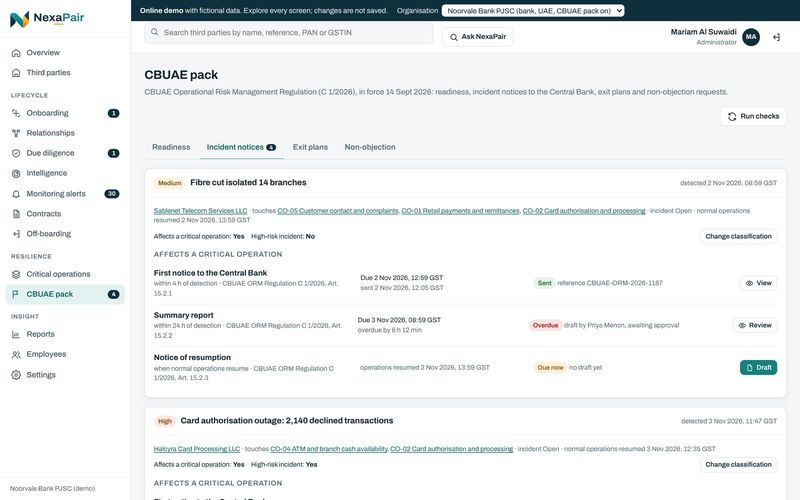
- LiveIncident records
- LiveIncident reporting clocks across regulators: CBUAE, ADGM and the "immediately" rules
UAE rules that apply
CBUAE For operational risk events that significantly affect, or may affect, Critical Operations (e.g. events that trigger BCP or DR, or materially affect customers, operations, profit or capital): first notify the CBUAE, naming the affected Critical Operations.
CBUAE Send a summary report covering the event, the actions taken, the likely impact and the expected recovery timeframe.
CBUAE Notify the CBUAE when normal operations resume. The CBUAE may also set other notifications case by case.
CBUAE Separate trigger: notify the CBUAE of any high-risk Incident, as defined by Board-approved classification criteria.
FSRA Notify the FSRA of a suspected material cyber incident immediately on discovery, with a 24-hour backstop for the initial report (Template A) emailed to incidents.fsra@adgm.com, copying the supervisor. Progress updates (Template B) follow at a frequency the supervisor sets.
VARA Report a material cybersecurity event, or an event that triggers the BCDR plan and materially affects operations, with its nature, scope, impact and mitigation, and whether other authorities were told.
Government and critical sectors Entities must report threats, hacks, leaks, interceptions or risks to DESC.
Federal law The controller reports a breach that harms privacy, confidentiality or security to the Data Office, with investigation results; data subjects may also need notice. Detailed timing awaits the Executive Regulations. Secondary source
Stage 8 of 9
Renewal and exit
What good looks like
Before a renewal or a change, check whether it is material and who must be told first. Each critical arrangement has a tested exit plan, and at the end access is removed and data returned or destroyed.
Usually owned by: Business owners, with Procurement, Legal and Information Security
Questions to ask
- Is a change of provider for a critical operation a material change that needs notice first?
- When was each exit plan last tested?
- Is vendor access removed on the day the relationship ends?
In NexaPair
- LiveExit plans
- LiveMaterial-change notice and non-objection gate
- LiveOff-boarding checklist
- LiveEquivalent-resilience and concentration checks
UAE rules that apply
CBUAE For material changes to Critical Operations (which can include a change of provider): notify the CBUAE with an external expert's report, and obtain written no-objection before implementing.
CBUAE Keep viable contingency and exit plans for third-party arrangements. The BCP must assess how hard the provider would be to substitute.
CBUAE The CBUAE may require an arrangement, or a Critical Operation that relies too heavily on providers, to be discontinued.
CBUAE Arrangements should allow the activity to move to another provider or back in-house without undue delay. Contingency plans and termination provisions are expected.
CBUAE Material cloud arrangements need tested continuity plans and specific exit plans.
Government and critical sectors Background verification of contractors and third-party users before access, and revocation of access within 24 hours of exit.
Stage 9 of 9
Board reporting
What good looks like
The full Board approves the strategy, the risk appetite and the disruption tolerance, and sees a short, regular view it can trace back to records.
Usually owned by: Risk, for the Board and its committees
Questions to ask
- Does the full Board approve the strategy and the disruption tolerance itself?
- Can each number in the Board pack be traced back to a record?
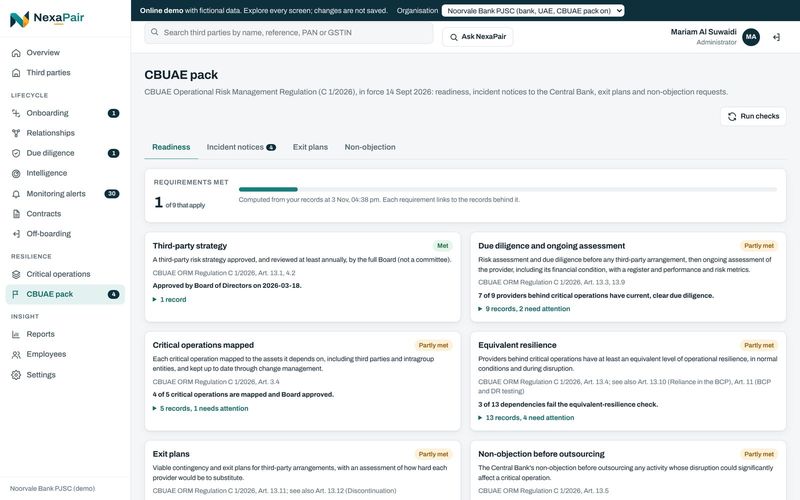
- Does the Board see which regulator requirements are not yet met?
What to show the Board
- Critical arrangements, by tier and by critical operation
- Reviews and due diligence overdue
- Open high-risk issues and their age
- Incidents, and whether each notice met its clock
- Exit plans tested in the last twelve months
- Regulator notices and non-objection requests pending
In NexaPair
- LiveBoard pack
- LiveReadiness view for each regulator, also in the Board pack
- LiveCSV and JSON exports of 10 registers, including the audit trail
UAE rules that apply
CBUAE Board members carry ultimate responsibility for the operational risk and resilience framework, even where Board committees exist.
CBUAE The full Board (not a committee) approves and reviews key operational risk and resilience strategies and policies, including risk appetite and disruption tolerance. The Board also approves the initial BCP and DR plans; their annual review may be delegated.
CBUAE The bank stays fully responsible for outsourced risks. It needs a Board-approved materiality policy, Board or committee approval of material arrangements, conflict-of-interest management, and timely reporting of material risks to the Board.
CBUAE Keep BCP and DR plans for Critical Operations, with annual second- and third-line review and at least annual testing.
This is a summary for orientation, not legal advice. Always rely on the official text, and take advice on your own situation. For federal legislation, the Arabic text prevails.
Standards alignment
Where NexaPair supports the international standards you may use.
Many UAE firms run their programme against international standards as well as their regulator's rules, and the DFSA's cyber rules point to recognised standards. The table shows which NexaPair records support each standard. Using NexaPair does not certify your organisation against any of them.
DFSA Keep a cyber risk management framework approved by the governing body and consistent with recognised standards (e.g. NIST CSF, ISO 27000, CIS), with senior management oversight. Secondary source
| Standard | What it covers | Where NexaPair supports it |
|---|---|---|
| ISO/IEC 27036 | Information security in supplier relationships, across the whole relationship. |
|
| ISO/IEC 27001:2022, Annex A 5.19 to 5.23 | Supplier controls: security in supplier relationships and agreements, the ICT supply chain, monitoring and change of supplier services, and cloud services. |
|
| ISO 22301 | Business continuity management, including the suppliers that critical activities depend on. |
|
| ISO 37001 | Anti-bribery management, including due diligence on business associates. |
|
| NIST SP 800-161 Rev. 1 | Cybersecurity supply chain risk management for systems and organisations. |
|
When a vendor offers evidence such as an ISO/IEC 27001 certificate or a SOC 2 Type II report, check its scope, its date and who issued it, and keep it with the due diligence case.
NexaPair's own certifications: [CERTIFICATION STATUS]. Trust and security